
What the robots are telling us | Business News
While setting their own athletic records at the robot Olympics, humanoid robots underline a visible shift from an engineering spectacle to being a commercial and trade leverage | Business News
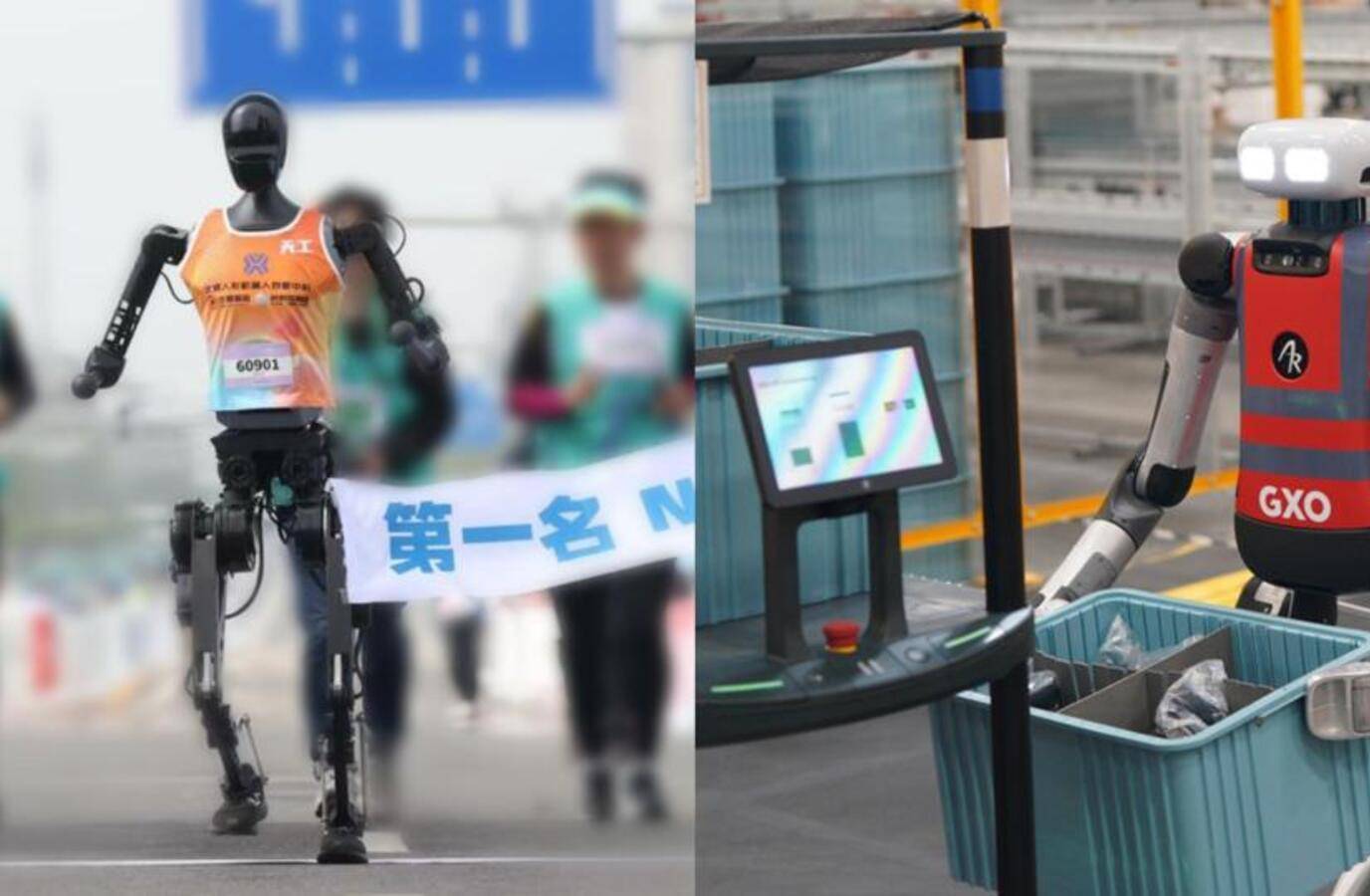
Amidst a spectacle at the World Humanoid Robot Games in Beijing a few days ago, a robot called Tiangong Ultra ran 100 metres in 8.64 seconds. Usain Bolt’s human world record is 9.58 seconds. The Tiangong Ultra is made by Chinese robotics company X-Humanoid. Let that sink in for a moment, because there’s more. The company made another robot that cleared 2.88 metres in the standing high jump. It cannot be technically said to have broken the 2.45 meter record set in 1993 by Cuba’s Javier Sotomayor because that was achieved using the Fosbury Flop running approach. The robot did a standing jump.A few clear takeaways have emerged in recent days. We’ve reached a stage in evolution where humanoid robots are more athletic and flexible. Although not always successful in the moment, engineering progress is rapid. Secondly, there is increasing business sense to deploy humanoid robots for certain tasks in closed environments, as latest market research data seems to suggest. And finally, with the hardware aspects mostly solved alongside strong actuators and dense batteries, focus shifts to the software layer that’ll define robotics.These weren’t demos in singularity (because these are pre-defined engineering applications, such as running in a straight line with some situational awareness), but a broader signal of progress. A robot Olympics that has quadrupled in size within a year’s time. Chinese robotics company Unitree’s IPO soared more than 600% on the day of listing in August. Research firm Smart Analytics Global (SAG) says humanoid robot shipments surged 272% year on year, to 19.1K units in 1H 2026. A key here is that industrial and commercial applications now make up more than 70% of industry volume. They expect global shipments to approach 60K units in 2026, nearly tripling year-on-year, with industry revenue reaching approximately US$1.6 billion.It wasn’t all success stories at the robot games. A robot made by smartphone company Honor lost a leg mid-sprint. Many more tripped, lost balance, or stumbled. One even went head-on into a wall at fair velocity and bounced off it. The organisers, for their part, added to the spectacle by carrying away injured robots on stretchers.Collectively, this is a sign of how far along humanoid robotics has come. Two years ago, humanoid robots couldn’t have done any of this. Some events including track events, football, gymnastics and table tennis allowed the robots to operate autonomously. There will be other scenarios where humans could remotely control actions.Two different racesIt is important to step back from the games in Beijing, and understand how the contours of the industry are shaping up. The SAG data indicates that in H1 2026, Chinese brands have as much as 93% share of global shipments for quadruped robots. Unitree leads with a 52% shipment share. The leading competition from elsewhere?Boston Dynamics, ANYbotics and Ghost Robotics all have 1% shipment share each in this period, with total shipments of robotics companies not based in China at 7%.It is not a lost battle, as Linda Sui, Founder and Principal Analyst at Smart Analytics Global points out. “Chinese vendors are pushing quadruped robots toward more affordable and higher-volume applications, while Western vendors remain concentrated in specialised industrial and defence markets where significantly higher ASPs (average selling price) can be supported,” she says.Samsung sped up plans for the humanoid robotics space by establishing a dedicated Robotics eXperience (RX) division. The company marked the backing this initiative with a 19 trillion won (~$14 billion USD) investment in July. LG Electronics and Nvidia confirmed collective development of a next-generation humanoid robot, a few weeks ago. This will use Nvidia’s Jetson Thor chips as well as the Isaac GR00T foundation model (as its brain), and scheduled for debut in Q1 2027.Boston Dynamics, which is owned by Hyundai, unveiled the production-ready Atlas at CES in January. Every 2026 unit manufactured has been committed to Hyundai’s own Robotics Metaplant Application Center, as well as to Google DeepMind, which is folding its Gemini Robotics models onto the platform.Speaking of Hyundai, in July, Hyundai’s Korean Metal Workers’ Union walked out at the Ulsan plant, its first full strike in a decade. This wasn’t another worker dispute nominally over wages, bonuses or retirement age, but for the first time, job security against physical AI and robotics. This is a direct result of the plans with Atlas.Figure AI has built over 1,000 of its Figure 03 robots. Some are now working inside BMW’s Spartanburg plant.Agility Robotics has announced plans to go public, unlike Unitree’s IPO method, but a SPAC or Special Purpose Acquisition Company merger with Churchill Capital Corp XI. “Agility is a humanoid first mover with proven technology, real-world deployments, and the trust of some of the world’s most demanding enterprises,” notes Michael Klein, Chairman and CEO of Churchill Capital Corp XI. Their latest generation Digit v5 is designed to be the world’s first AI-enabled cooperatively safe humanoid robot.When Elon Musk, during the Tesla Q4 2025 earnings call said that their Optimus humanoid robot “is not in usage in our factories in a material way,” it was as much a warning as it was a wake up call. Musk also attributed the Optimus production slowdown to China’s restrictions on exports of rare earth magnets. Tesla has since started production of the Optimus Gen 3 and has repurposed the Model S and Model X assembly area at its Fremont, California factory into its very first dedicated production line for the robot.Optimus Gen 3 features redesigned 22-Degree-of-Freedom (DoF) hands equipped with 50 actuators for human-like dexterity, and runs on an AI5 computer chip tailored specifically for robotics. Outside the US, Tesla has deployed a limited pilot trial at Giga Berlin and is testing practical logistics tasks such as sorting and loading battery cell carriers.The US administration is responding to the dominance of Chinese humanoid robots, by banning imports of foreign-made humanoid and quadruped robots. This means robots have now officially joined chips, EVs and drones as technology that’s crucial to national security.There’s no proof yet that robots can fold clean laundry. But they are already running very fast, jumping very high, and have begun to rearrange research plans. That may be a trick of consequence.