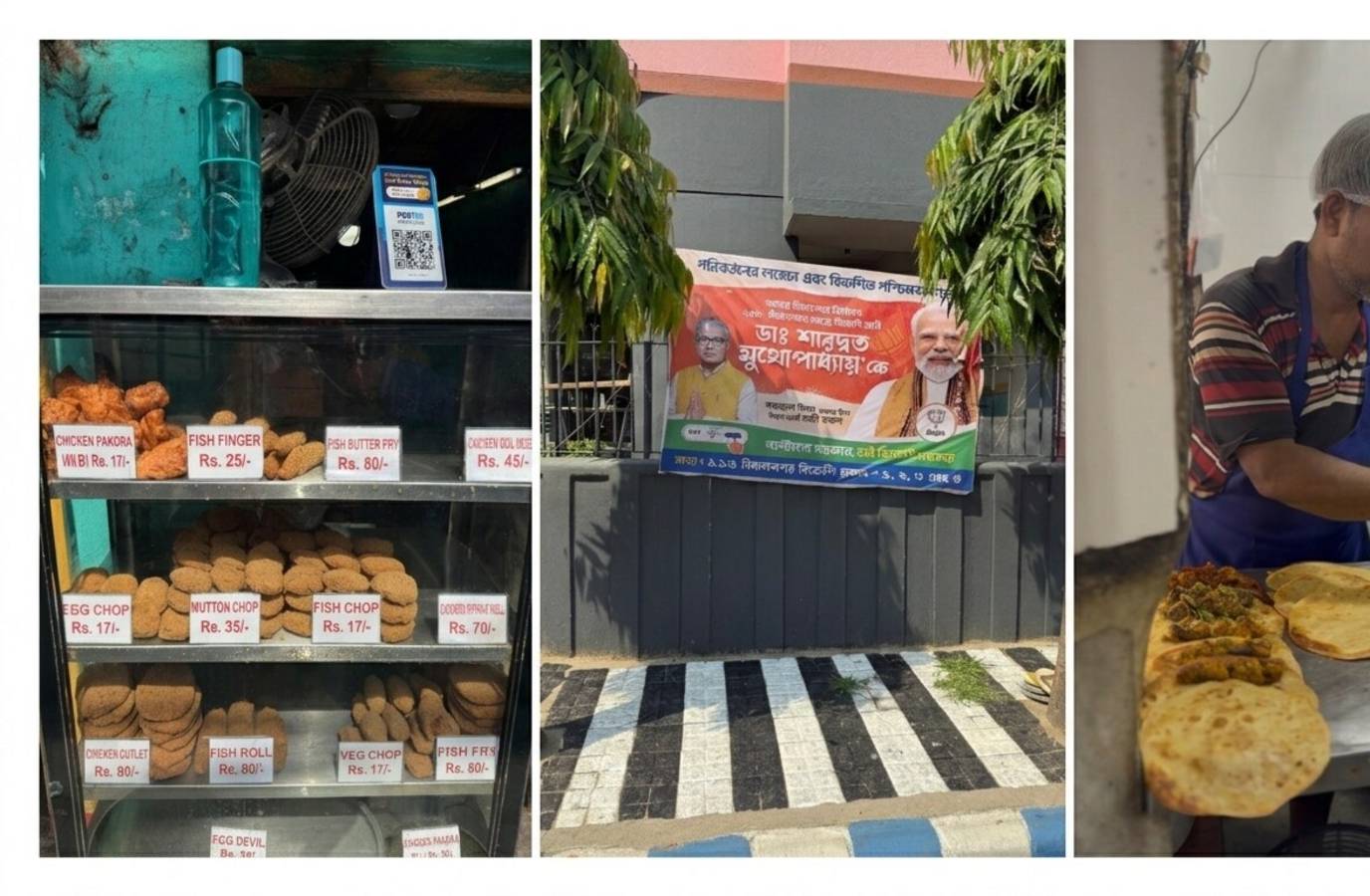
Amid the West Bengal election chatter, one thing that has emerged as the biggest talking point is non-veg — with chief minister Mamata Banerjee claiming that the Bharatiya Janata Party will make access to non-vegetarian food difficult for Bengalis if voted to power. The BJP, on the other hand, has been going all out to deem these claims baseless, so much so that one of its candidates was recently seen campaigning with a fish.
For many in Bengal, food is inseparable from identity. Maach and maangsho (fish and mutton) are more than just food. They are an emotion for Bengalis. Conversations across some of the city’s most popular eating hubs - from biryani outlets and kathi roll joints to iconic cabins - have increasingly shifted towards an unusual political question: food.
A bike taxi rider told me that he feels the non-veg debate is not something locals are particularly concerned about. He said it is ultimately up to the people what they want to eat and, in a state like West Bengal where non-veg is a staple, no party or its offshoots will be able to impose anything.
Among those countering the narrative was Sharadwat Mukherjee, the BJP candidate from Bidhannagar, who was seen campaigning with a fish - an image that quickly drew attention this election season. He said the campaign aimed to respond to what he described as opposition claims that a BJP government would turn West Bengal into a vegetarian state, depriving Bengalis of fish, a cultural staple.
He added that he believes such narratives set by political parties are “useless things which turn people into something they shouldn’t be”. “It is very sad that in Bengal, the diet of a person has become an election issue. In other states like Maharashtra, Gujarat and Tamil Nadu, debates are usually about investment, education and development,” Mukherjee added.