
Mystery Comet 3I/ATLAS Defies Conventions: No Tail in Sight as it Passes the Sun
The “Manhattan-sized” interstellar object defies comet norms and reignites alien-craft theories
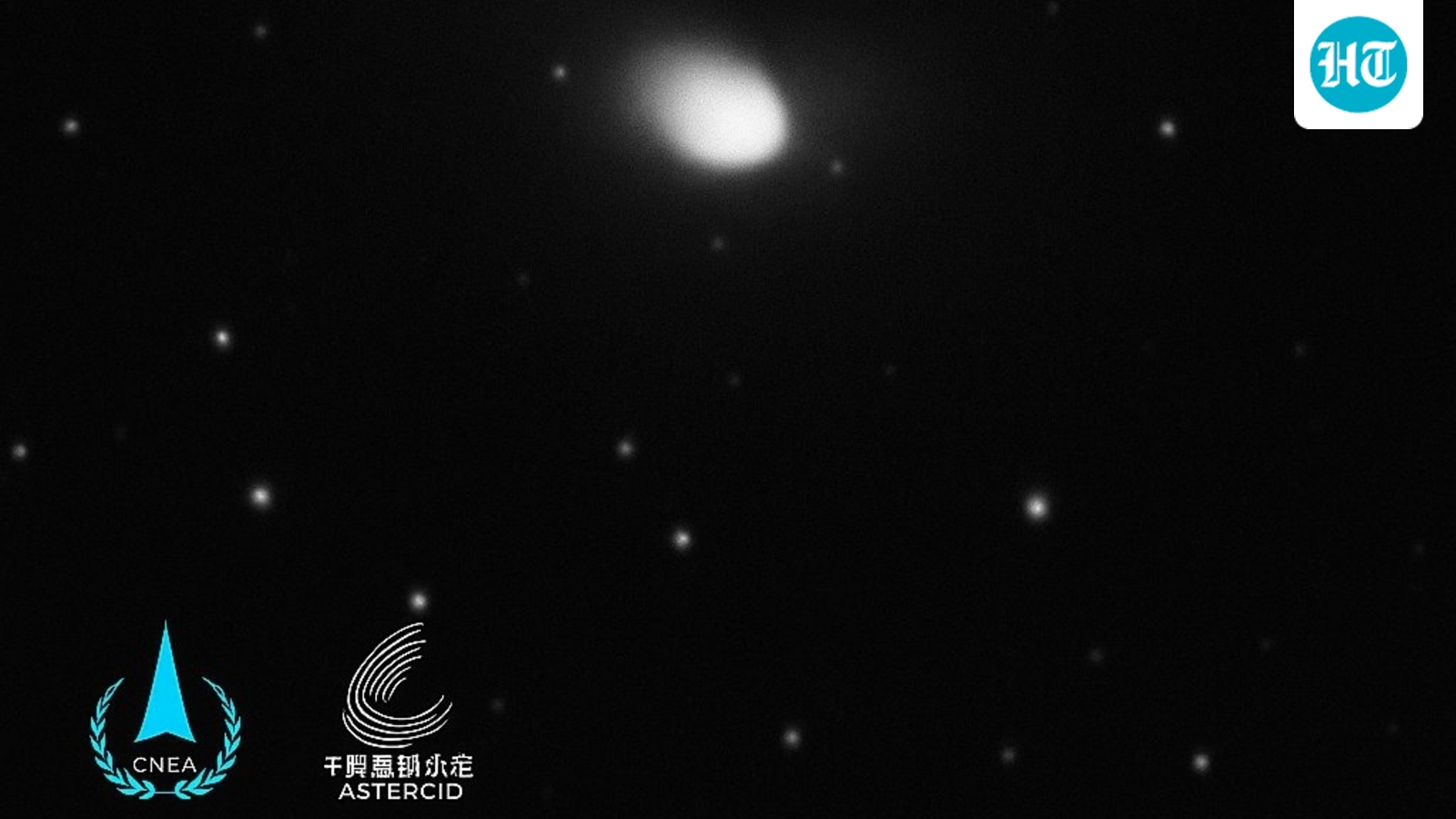
A bizarre interstellar object, 3I/ATLAS, has left scientists stunned by its unconventional behavior. Recent images of the comet, taken on November 5 from Spain's R. Naves Observatory, show no visible tail, a characteristic feature of comets after they approach the Sun.
Astrophysicists are struggling to explain this phenomenon, as it contradicts traditional models of comets. According to calculations by Avi Loeb, a Harvard astrophysicist, a comet should produce a massive 'coma' of gas and dust, which is then blown into a tail, accounting for 13% of its mass. However, 3I/ATLAS continues to defy expectations, with no tail in sight.
Loeb suggests that if 3I/ATLAS maintains its tail-less appearance, it may not be a naturally occurring comet. The object's behavior is already raising eyebrows, as it has exhibited non-gravitational acceleration, massive evaporation, and an 'anti-tail' pointing towards the Sun.
This is not the first time 3I/ATLAS has presented anomalies. It brightened fivefold after perihelion, took on a peculiar green hue, and followed a hyperbolic trajectory, meaning it originated from outside our Solar System.
As 3I/ATLAS continues its journey, scientists are eager to learn more about this enigmatic object. The best image of 3I/ATLAS is expected from NASA's Mars Orbiter's HiRISE camera. However, the ongoing government shutdown has delayed the release of these images.
In the coming months, two orbiters from NASA and the European Space Agency will observe 3I/ATLAS as it approaches Jupiter on March 16, 2026. This final stage of its journey will provide valuable insights into the nature of this mysterious comet, which first entered our solar system on June 14, 2025.


