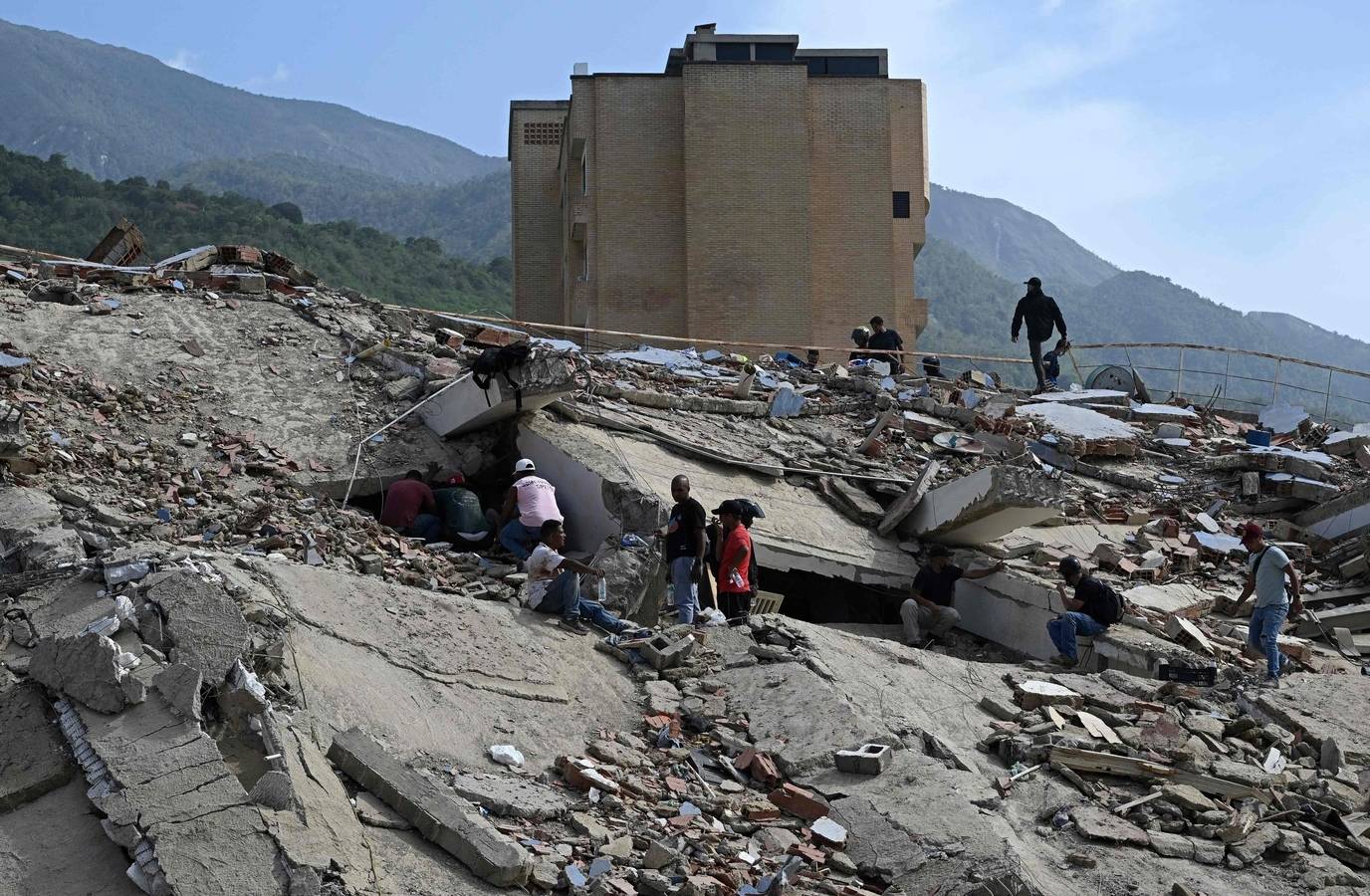
The recent earthquakes in Venezuela were unusual not just because of their size, but because they struck just 39 seconds apart, ruptured along the boundary between two tectonic plates and sent the strongest tremors towards the country's most densely populated coastline.
The first earthquake measured magnitude 7.2, but instead of being followed by a series of smaller aftershocks, it was followed almost immediately by a larger magnitude 7.5 earthquake. Seismologists describe such events as an earthquake 'doublet'—when two major earthquakes occur close together in both time and location.
A sideways collision between tectonic plates caused the earthquakes, which occurred along the boundary where the Caribbean Plate and the South American Plate slide horizontally past one another.
Scientists say the 7.2-magnitude quake was followed by an even stronger 7.5-magnitude mainshock just 39 seconds later. This 'doublet' meant the ground began shaking, briefly eased, and then shook violently again, extending the duration of intense shaking and increasing the likelihood of structural damage compared with a single earthquake of similar size.
The rupture appears to have propagated mainly eastward rather than evenly in both directions, focusing much of the earthquake's energy towards Venezuela's central coast.
The earthquakes were caused by a sideways movement of the Caribbean and South American plates, which generated seismic waves that travelled through northern Venezuela.
The epicentre lay near a stretch of coast that includes La Guaira, one of the country's most important ports and the gateway to the capital.
Early analyses indicate that the rupture tore predominantly eastward along the fault, making ground shaking significantly stronger for communities lying in the direction of the rupture.
The strongest seismic waves were channelled along the densely populated coastline, amplifying the impact on urban centres.
A preliminary rupture model suggests the earthquake behaved as one continuous rupture with two distinct pulses of energy.