ISRO's Gaganyaan Mission Soars: Main Parachutes Test a Major Success
For the Gaganyaan Crew Module, the parachute system comprises a total of 10 parachutes of 4 types. | India News
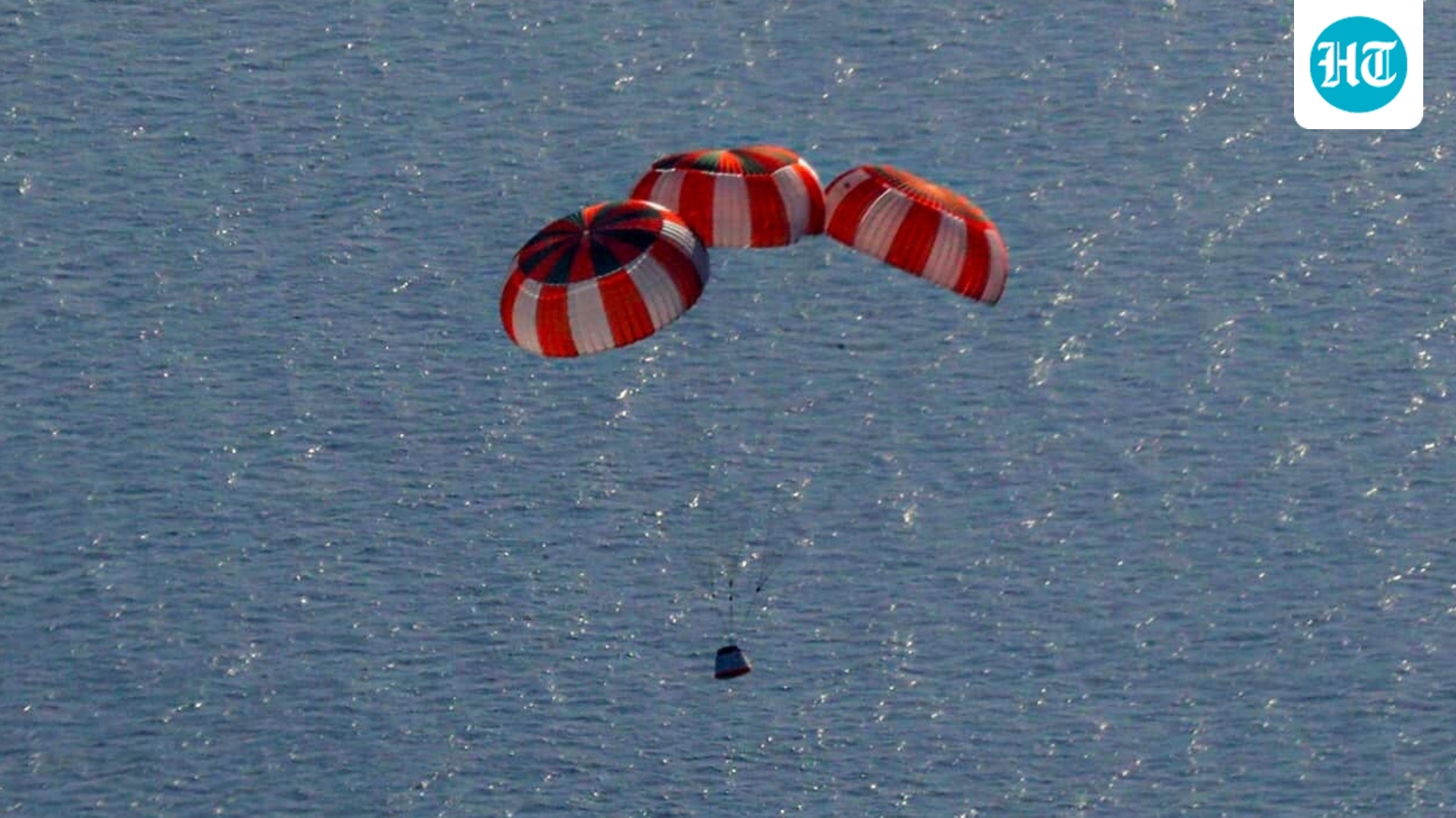
In a significant breakthrough, the Indian Space Research Organisation (ISRO) has successfully tested the Main Parachutes for the Gaganyaan Crew Module at the Babina Field Firing Range in Uttar Pradesh's Jhansi. The trial, conducted on November 3, is a crucial step in the qualification of the parachute system for the Gaganyaan Mission.
The parachute system, comprising 10 parachutes of four types, is designed to ensure a safe touchdown of the Crew Module. The sequence begins with two apex cover separation parachutes, followed by two drogue parachutes that stabilise and decelerate the module. Three pilot parachutes are then deployed to extract the main parachutes, which slow down the Crew Module further.
The main parachutes deploy in a step-by-step process called reefed inflation, where the parachute opens partially and then fully opens after a predetermined period. This process is critical, as demonstrated in the test, where one of the extreme scenarios of delay in disreefing between the two main parachutes was successfully simulated.
The test involved dropping a simulated mass equivalent to the Crew Module from an altitude of 2.5 km using the Indian Air Force's IL-76 aircraft. The parachute system deployed as planned, and the sequence was executed flawlessly. The successful completion of this test marks a significant step towards qualifying the parachute system for human spaceflight, with active participation from various organisations, including the Vikram Sarabhai Space Centre, ADRDE, DRDO, Indian Air Force, and the Indian Army.