RUSSIA'S DEPENDENCE on China to sustain its war against Ukraine has steadily increased as Western sanctions have intensified.
China maintains that it is neutral in the conflict, denying it provides Russia with lethal aid, such as finished weapons systems.
But by supplying huge volumes of "dual-use" components and materials, it in effect underwrites Russia's military-industrial base.
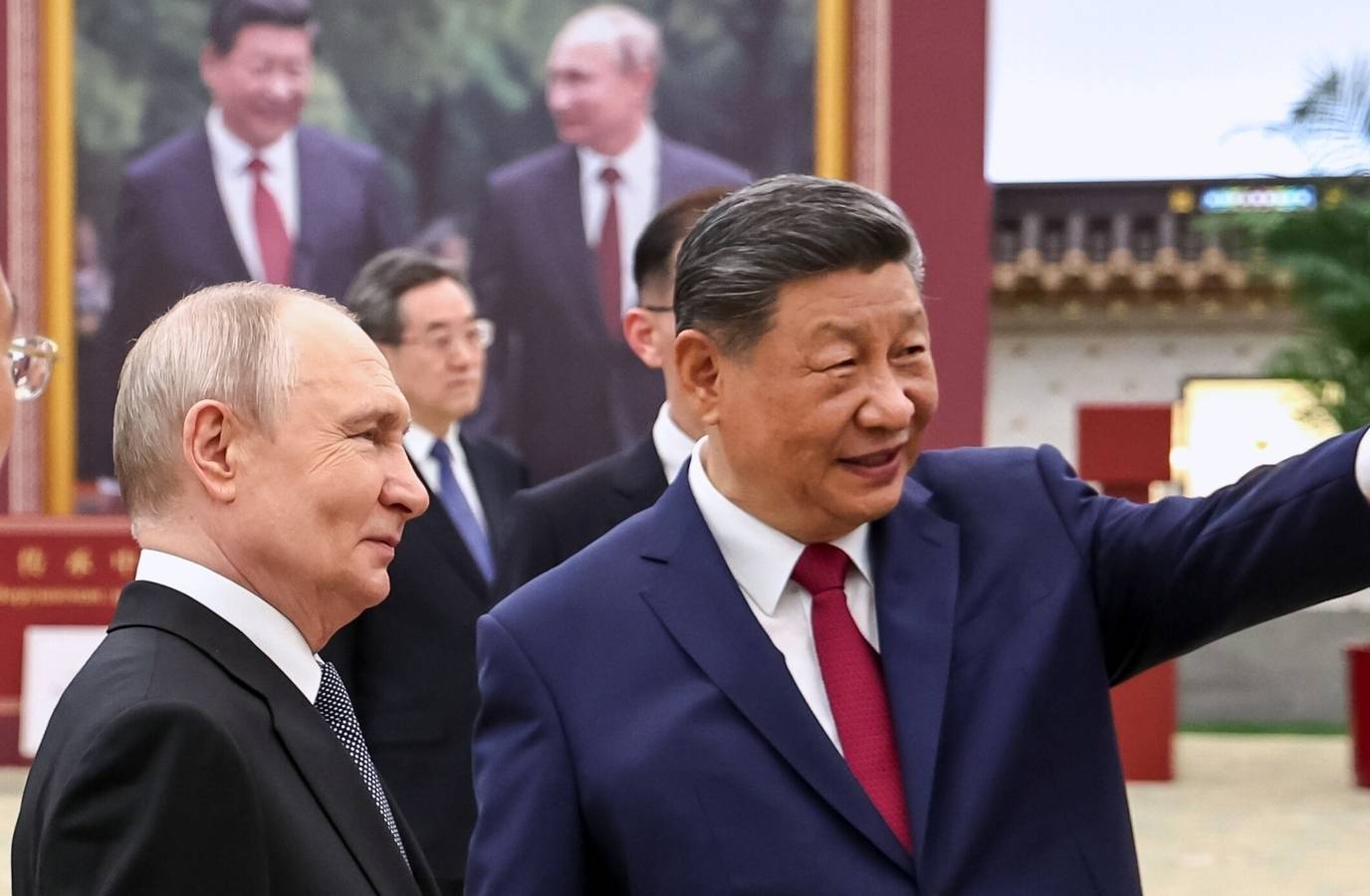
Vladimir Putin arrived in Beijing on May 19th as a supplicant in many respects.
Chinese microelectronics and semiconductors are critical to Russia's ability to churn out the precision-guided missiles and drones which pound Ukrainian cities.
China also supplies most of the commercial first-person-view (FPV) drones and supporting technologies Russia needs.
China does provide Ukraine with many of the same components—cameras, motors, transmissions—needed by FPV drones.
But nearly all of their assembly is now Ukrainian.
Russia, Ukraine knows, will always be first in the queue.
Russia's weapons and ammunition factories are almost entirely reliant on Chinese computer-numerical-control machine tools.
The Jamestown Foundation, a Washington-based think-tank, estimates that around 90% of Russian machine-tool imports are now from China.
Another critical dependency on China, according to Western officials, is for nitrocellulose, the cotton-derived feedstock that is the propellant for artillery shells, tank rounds and missiles.
Russia produces its own at a handful of explosives factories (which the Ukrainians target) but not nearly enough for its wartime needs.
Turkey, through various intermediaries, provided about half of Russia's imports of nitrocellulose until recently, but the firms involved are now subject to heavy sanctions.
Consequently China, allege the officials, is ramping up its sales of nitrocellulose to Russia through Norinco, a massive state-owned armaments firm, which uses a pair of subsidiaries.
The company has not commented publicly on this.
China insists that nitrocellulose is a dual-use product needed for paints and lacquer.
To maintain the obfuscation, the four main Russian gunpowder factories reportedly run sister civilian operations.
Norinco, Western officials say, tries to conceal sales behind shell companies and foreign intermediaries.
China is also stepping up its exports of cotton pulp and cotton cellulose from which nitrocellulose is made.
Nearly all Russia's cotton pulp previously came from Uzbekistan and Kazakhstan.
But newish sanctions packages from the European Union, introduced last year and this year, on designated Uzbek and Kazakh exporters have begun to have some impact.
There is little likelihood of China reducing its support for Russia's war machine.
Chinese firms are earning handsome profits while Russia provides cheap oil and gas in return.
The polite fiction of "dual-use" has been artfully maintained.
Moreover, to Beijing's satisfaction, even when the war ends, Russia's dependency on China as a needy junior partner seems certain to endure.