
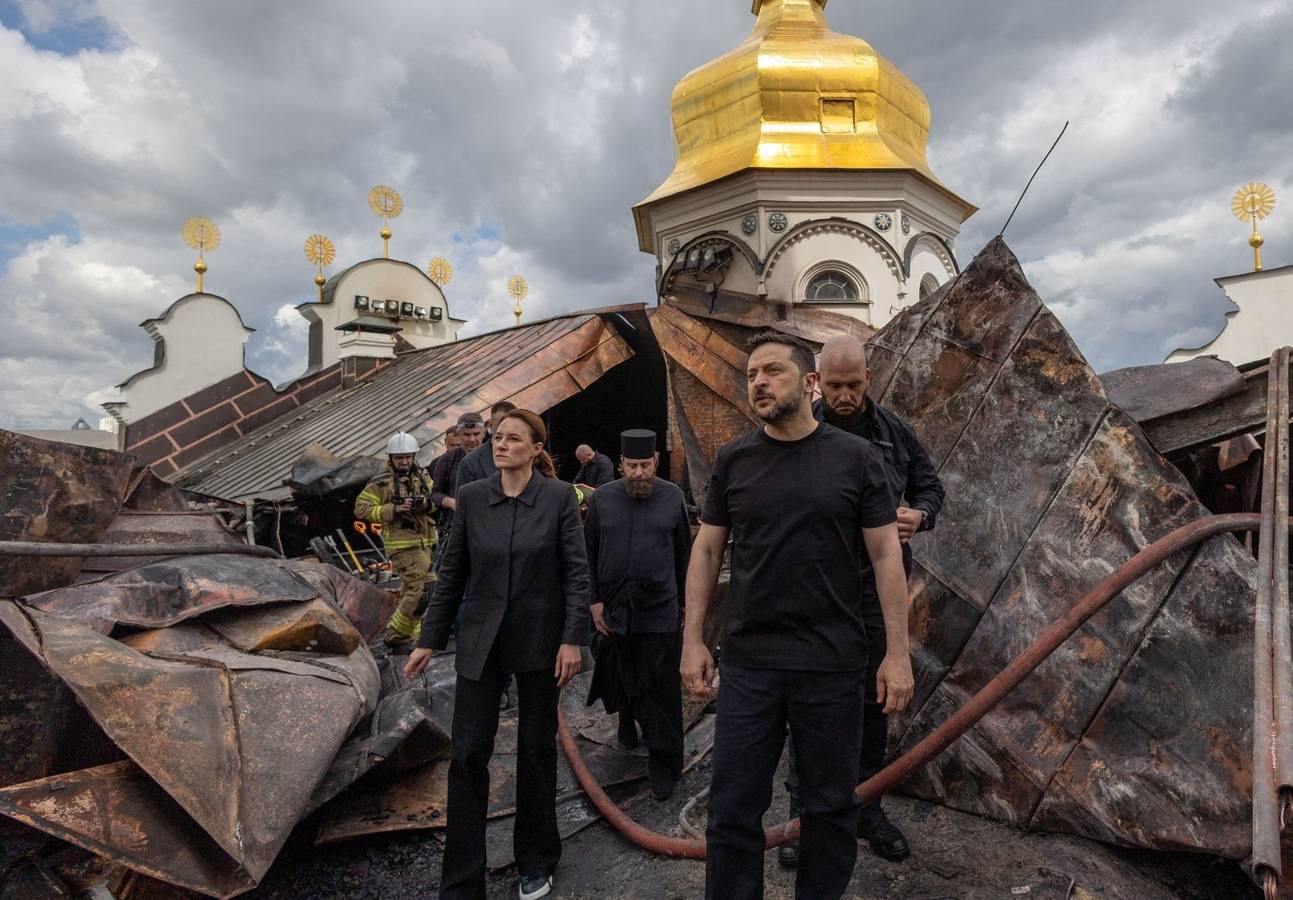
Ukrainians awoke on Monday to a familiar stench of kerosene, fire and blood. Russia's latest attack, involving 611 drones and 70 missiles, focused on Kyiv. The capital's ancient Pechersk Lavra monastery complex, a UNESCO World Heritage site, was hit by what local authorities described as a direct strike.
Elsewhere the primary targets appeared to be military-production facilities and power infrastructure, but as usual some missiles landed in bedrooms. Eight residential blocks were hit. In Kyiv at least five people died and three dozen were injured. In Kharkiv, at least five emergency workers were killed in a deliberate 'double-tap' strike.
The deaths continue a grim trend: May was the deadliest month for Ukrainian civilians since 2022. The intensifying air war is in part a reflection of Russia's increasing difficulties on the ground.
Ukraine has prioritised an asymmetric mid-range drone campaign, menacing Russian supply routes with new precision weapons, the latest of them semi-automated. Among other things, this has caused a petrol shortage in annexed Crimea.
Russia, for its part, has simply bombed Ukrainian cities harder and more ruthlessly. Its aims are not only military but psychological: to break locals' morale, and foreign allies' confidence that Ukraine can defend itself.
Ukraine's air-defence operatives, nights like these are increasingly frantic. At the worst moments the waves of incoming drones and missiles turn their radar monitors into a sea of red dots.
Ukraine desperately wants to return to the select group of states that can mass-produce ballistic and advanced cruise missiles, which are harder to intercept and more destructive on impact.
It has at least two ballistic missiles in testing phase. The Sapsan/Hrim-2, developed by Pivdenmash, the Soviet-era centre of Ukrainian rocket-making, has been in development for decades but has been undermined by corruption and Russian infiltration.
The fp-7, a smaller, shorter-range project from Fire Point, combines new Western avionics with an existing Soviet airframe design. The latter is probably closer to serial production.
Producing enough missiles that can beat Russian defences is not straightforward. Rockets are far more complicated than drones, requiring precision in everything from engines to terminal-guidance avionics.
How close Ukraine is depends on whom you ask. Volodymyr Zelensky, in an interview with British media, insisted Ukraine was 'very close' to bringing the ballistic war to the Kremlin.